
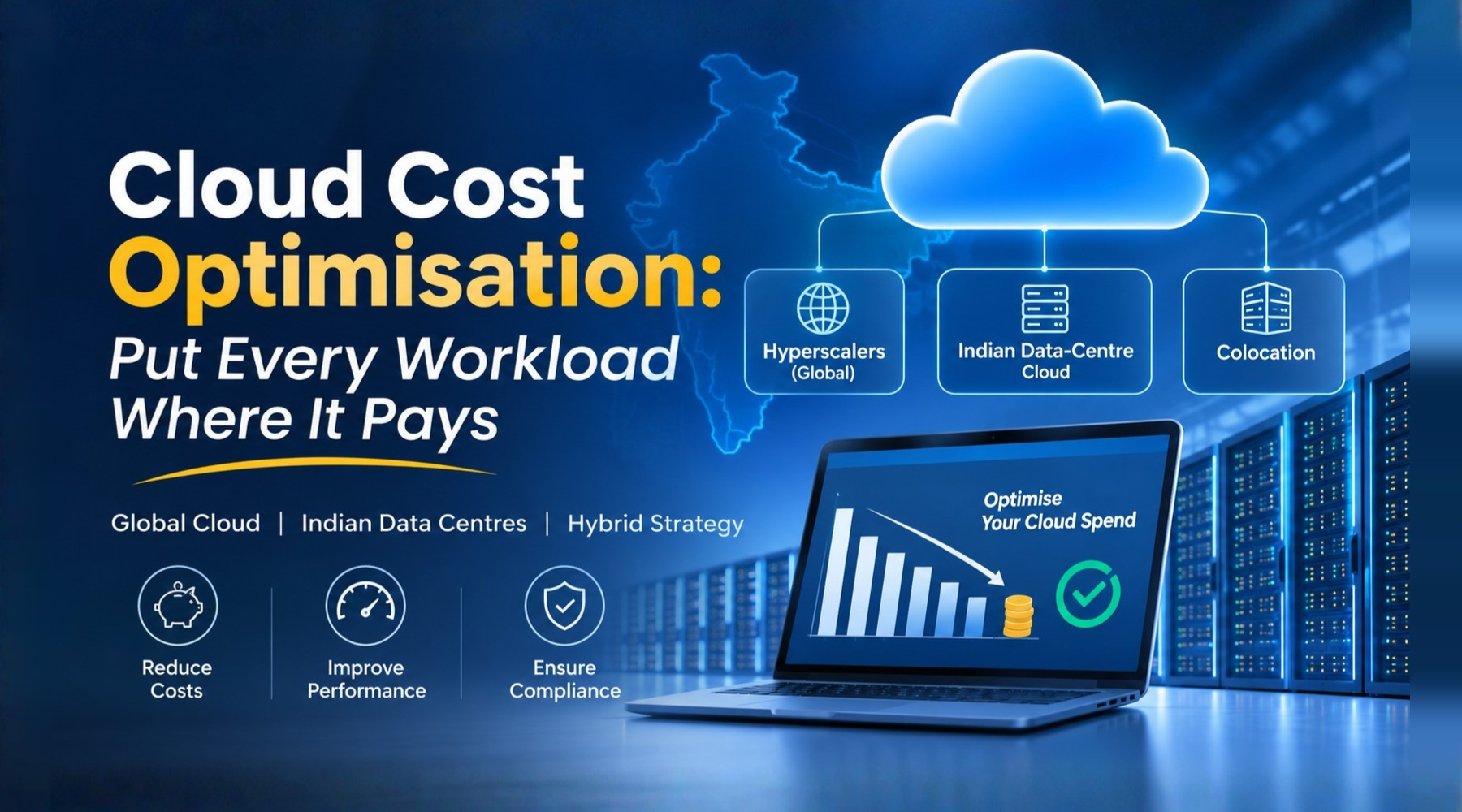
How to cut cloud costs, and when Indian data-centre clouds make more sense than the hyperscalers.
Step 1: Optimise what you already have
- Right-size over-provisioned servers and switch off dev/test environments at night and on weekends.
- Commit to reserved capacity or savings plans for steady, always-on usage.
- Tier storage, and delete orphaned disks, snapshots and old backups.
- Watch data-transfer (egress) charges. They often hide in plain sight.
- Tag everything and show each team its own spend. Visibility changes behaviour (FinOps).
These steps typically deliver the quickest savings. But some workloads stay expensive however well they are tuned, because they simply don’t need what a hyperscaler is best at.
Step 2: Ask where each workload belongs
Hyperscalers excel at elastic, global, service-rich applications. Many business systems are none of these: they run 24×7 at a steady load, serve users in India, and hold data that must stay in India. For those, Indian data-centre-based cloud offerings from providers such as Yotta, Sify and NTT deserve a serious look.
Step 3: What is easiest to move?
| Move first (easy wins) | Move with planning | Usually keep on the hyperscaler |
| •Backups, archives and DR copies • Dev/test and UAT environments • Steady-state VMs: ERP, line-of-business and internal apps • File servers and document repositories • Batch AI training and inference on GPUs | •Databases with predictable load • Core banking, lending and policy systems (with a tested cutover) • Analytics and data warehouses with large storage • Applications on containers / Kubernetes | •Apps built on proprietary managed services (serverless, managed AI or analytics) • Globally distributed, highly spiky customer-facing apps • Workloads tied into SaaS ecosystems such as Microsoft 365 • Short-lived experiments |
Why consider Indian data-centre clouds ?
•Predictable, rupee-based pricing. Fixed monthly pricing for steady workloads, with no exposure to dollar movements.
• Simpler data-transfer costs. Data-heavy applications often avoid the variable egress charges that inflate hyperscaler bills. Compare offers carefully.
• Data residency and control. Data stays in Indian facilities under Indian operators, which helps with the DPDP Act and with RBI, SEBI and IRDAI expectations.
• Low latency for Indian users, from data centres in Mumbai, Chennai, Delhi NCR, Bengaluru, Hyderabad and beyond.
• Sovereign GPU capacity for AI, billed in rupees, for training and inference without exporting data.
• Hybrid by design. Private cloud next to your colocation racks, with direct links to Azure, AWS or Google Cloud for the services you keep there.
The best answer is usually hybrid
Moving everything is rarely right, and neither is moving nothing. A phased approach works best: measure current spend per workload, optimise the quick wins, place each workload on cost, performance and compliance, then move in waves, starting with low-risk systems, and finally run everything as one estate with a single view of cost. Done well, the result is a cloud bill you can predict, compliance you can evidence, and the freedom to use each provider for what it does best
Not sure where to start? Book a Hybrid Infrastructure Assessment.
We map every workload to hyperscale cloud, Indian cloud or colocation, with a 3-year cost comparison. Right workload. Right place. Right cost.
Leave a Comment