
The business risk: loss of control, production and service continuity
Recent incidents show that attackers can disable controllers, change process settings and interrupt essential services. A factory can also lose production when its supporting IT environment fails, even without a confirmed compromise of its machines. This is a curated selection based on operational significance and available public evidence, rather than a global ranking by financial loss. Four cases involve direct OT interference; the fifth illustrates disruption through supporting IT.
5 Major OT Cyberattacks1. Poland Energy Infrastructure Attack
29 December 2025; follow-up published 8 August 2026 | Direct OT attack.
Industry: Power and Energy
Coordinated attacks targeted more than 30 wind and solar farms, a manufacturer and a large combined heat and power plant. CERT Polska documented corrupted RTU firmware, destructive device changes and default credentials.
Operational Impact
Renewable facilities lost communication and remote control, while electricity generation continued. A follow-up identified a second, smaller heat-and-power plant where Siemens PLCs were switched to STOP, briefly stopping a steam turbine and process-water treatment.
Key Lesson: Protect remote-access equipment, remove default accounts, segment field networks and retain tested controller backups. Private cellular connectivity also needs security controls.
2. Iranian-affiliated US PLC campaign
Observed since at least March 2026; advisory 7 April, updated 22 July | Direct OT campaign
Industry: Energy, Water, and Government Facilities
US agencies confirmed attacks against internet-facing PLCs across energy, water and government facilities. The original advisory identified Rockwell Automation/Allen-Bradley devices, including CompactLogix and Micro850.
Operational Impact
Attackers interfered with PLC project files and altered HMI/SCADA data. Some victims experienced operational disruption and financial loss. The July update added observed targeting of Schneider Electric and Siemens devices.
Key Lesson: Remove direct controller internet exposure, broker remote access through controlled gateways and validate running logic against approved backups. Detect program changes as well as suspicious logins.
3. US water and wastewater PLC lockouts
Incidents reported since 27 July 2026; FBI/EPA alert 30 July | Direct OT attack wave
Industry: Water and Wastewater Management
Utilities in at least seven states reported incidents. Attackers remotely accessed exposed MicroLogix 1100/1400 controllers and changed IP addresses and passwords. At least one organization found changed PLC project files.
Operational Impact
Victims lost monitoring and, in some cases, control of connected equipment. Reported physical effects included pressure loss and flooding. Severity depended on controller function and the ability to run manually.
Key Lesson: Audit contractor-installed connectivity across all sites, restrict authorized device communication and test manual operation and controller recovery procedures.
4. French Supermarket Refrigeration Attacks
Night of 11-12 October 2026; reported 12 October | Direct cold-chain OT attack
Industry: Food Retail and Cold-Chain Management
Multiple retail chains confirmed refrigeration disruption. Intermarche told BleepingComputer that a cyberattack reportedly affecting a refrigeration-management service provider had left fresh and frozen display units out of service.
Operational Impact
Affected stores removed food from compromised refrigeration units. Coopérative U confirmed attacks on refrigeration equipment. This illustrates how connected physical systems can disrupt food availability and stock integrity.
Key Lesson: Treat refrigeration and building controls as critical OT. Review supplier access, isolate management interfaces and keep independent temperature alarms and local response procedures.
5. Stryker Global Industrial Disruption
11 March 2026 | Supporting IT attack with manufacturing impact.
Industry: Medical Devices and Manufacturing
What happened. Stryker disclosed a cyberattack that disrupted its global Microsoft environment. Its subsequent SEC filing confirmed a material impact on operations and first-quarter financial results.
Operational Impact
Manufacturing and supporting commercial operations required restoration. By the amended filing, the company said its global manufacturing network was fully operational and ordering and distribution systems had been restored.
Key Lesson: Protect supporting IT infrastructure and develop recovery plans covering both IT and OT environments.
Key Cybersecurity Lessons
Map plant dependencies on identity, ordering and distribution systems. Test continuity plans for an IT outage alongside controller recovery plans.
Common Cybersecurity Lessons
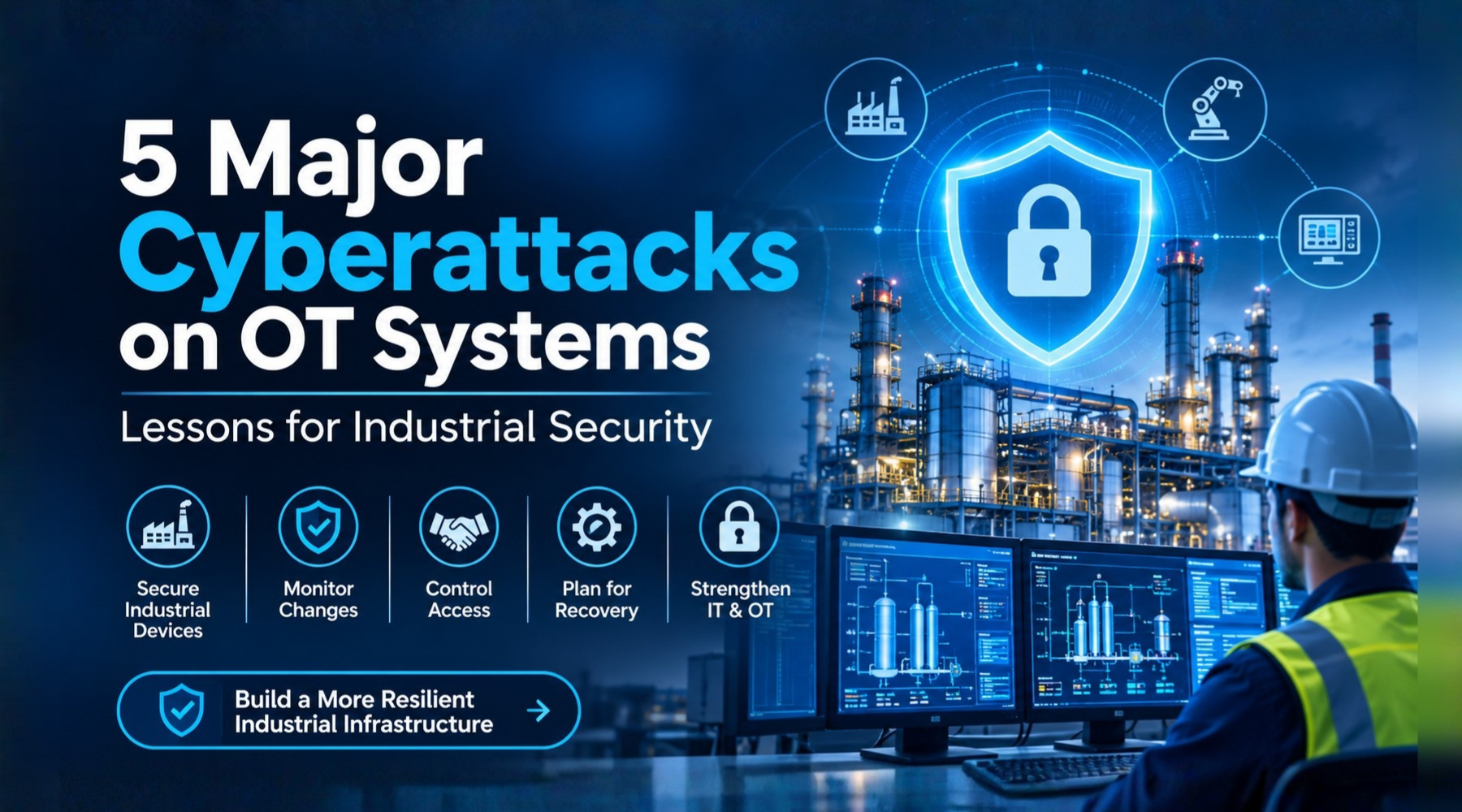
The five incidents highlight five key priorities:
- Secure Industrial Devices: Remove unnecessary internet exposure.
- Monitor System Changes: Detect unauthorized PLC and configuration changes.
- Control Third-Party Access: Use secure gateways and restricted vendor accounts.
- Protect IT Dependencies: Secure business systems that support manufacturing.
- Prepare for Recovery: Maintain offline backups and test recovery procedures.
Practical priorities for Gujarat industrial customers
The following recommendations combine agency guidance with practical implications drawn from the cases.
- Find exposure. Inventory PLCs, RTUs, engineering workstations, refrigeration controls and cellular routers; identify internet access and undocumented vendor connections.
- Control access. Remove direct OT internet exposure; use gateways, MFA and named, time-limited vendor access. Separate IT and OT with explicitly permitted communication.
- Protect integrity. Remove default credentials; check controller configurations and logic against approved baselines; apply vendor updates through planned maintenance.
- Detect process threats. Monitor changes to programs, operating modes, passwords, network settings and unusual process values. Link alerts to plant operators and the SOC.
- Prove recovery. Keep offline copies of logic and configurations, test restoration and safe manual operation, and rehearse a plant-specific incident response.
Conclusion
The five cyber incidents demonstrate how cybersecurity threats can disrupt industrial operations and business continuity. Securing connected devices, controlling access, monitoring threats, and preparing for recovery are essential to protecting industrial environments.
Leave a Comment